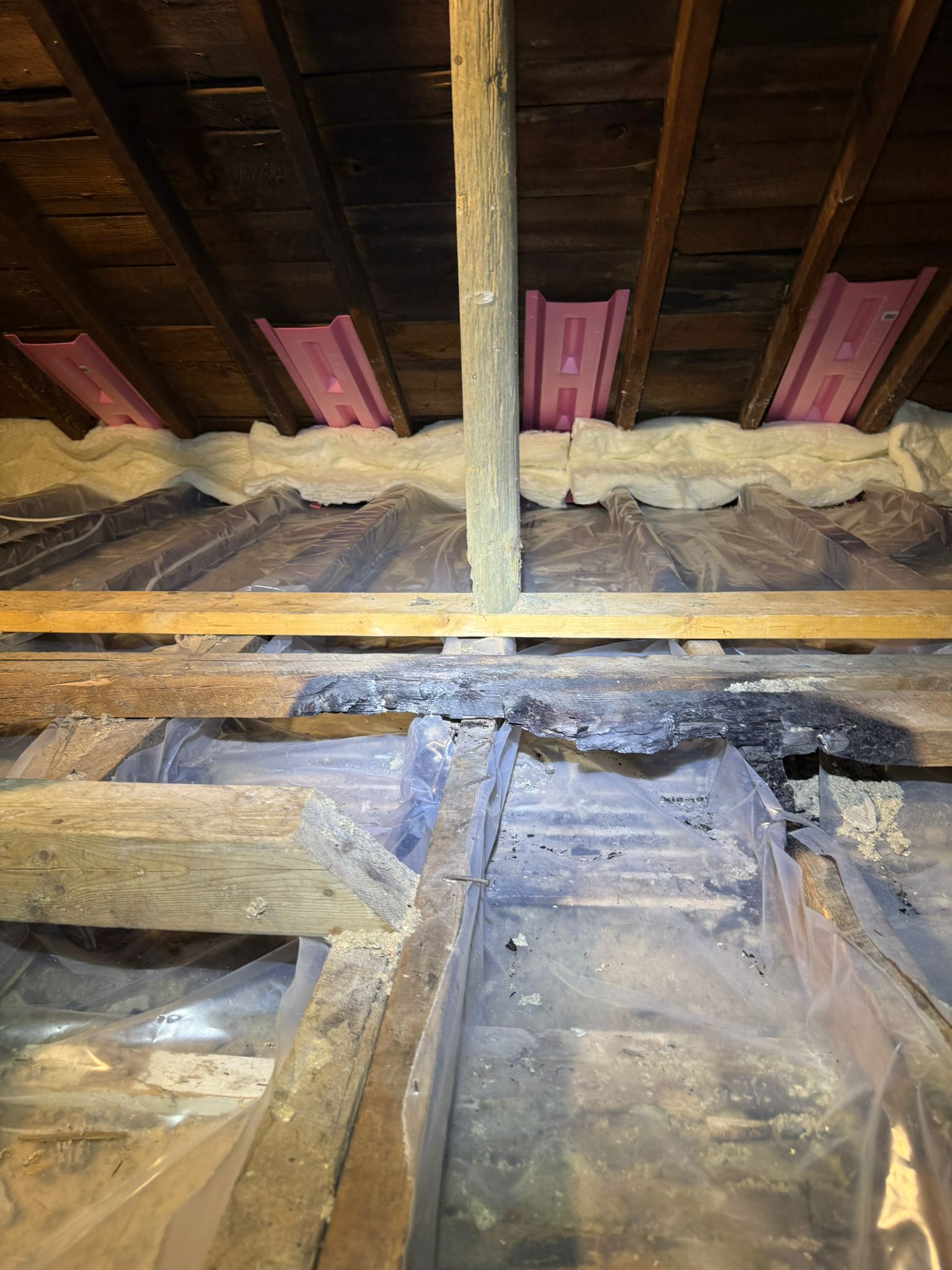
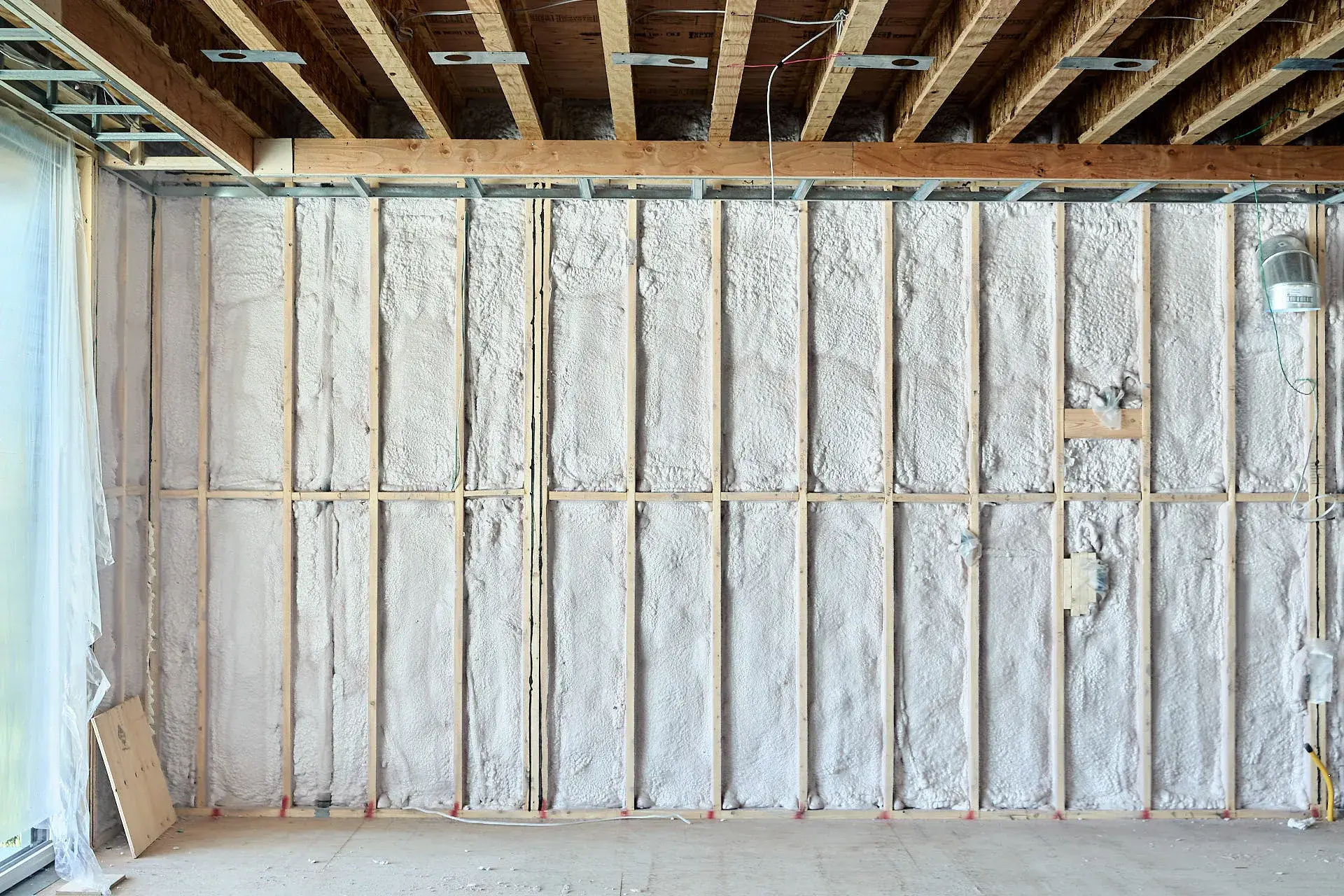
Spray foam is the premium end of the insulation market. It costs more than blown-in or batt, and for a lot of attic jobs it’s more than a homeowner needs. But for the right problem — a freezing room above the garage, a damp basement, drafty rim joists — nothing else does the job as well.
This is an honest breakdown of what spray foam is, the two types, where it genuinely outperforms cheaper options, and where it doesn’t.
What spray foam actually does differently
Most insulation slows heat from moving through it. Spray foam does that too — but it also air-seals. Two chemical components mix at the spray gun tip and expand on contact, filling the cavity and hardening into a continuous barrier that stops air leakage rather than just resisting it.
That distinction matters. A lot of what makes a home uncomfortable isn’t slow heat transfer through insulation — it’s air physically leaking in and out through gaps, cracks, and penetrations. Spray foam addresses both at once. We install Insulthane Extreme by Elastochem, and you don’t need to leave your home during installation.
Open-cell vs. closed-cell: the two types explained
Open-cell (½ lb, low-density) is a lighter, flexible foam that expands significantly on application. It runs roughly R-3.5 to R-3.8 per inch. It’s excellent for interior walls, sound dampening, and general air sealing where a vapour barrier isn’t the priority. (R-value ranges are commonly cited industry figures and vary by product.)
Closed-cell (2 lb, high-density) is a denser, rigid foam that delivers roughly R-6.0 to R-7.0 per inch — the highest R-value per inch of any insulation we install. At sufficient thickness it also acts as its own vapour barrier, and it adds structural rigidity. This is the one for basements, crawlspaces, rim joists, and cold rooms above garages.
The higher R-value per inch is a real advantage where space is tight. In a rim joist or a shallow cavity, closed-cell foam hits a target R-value in far less thickness than blown-in ever could.
Where spray foam is genuinely the right answer
The cold room above the garage. This is one of the most common complaints we hear in Kitchener. Builders typically fill garage ceilings with fibreglass batt, which isn’t airtight — so the room above stays cold no matter how high you crank the heat. The real fix is removing the drywall, removing the old batt, and spray-foaming the cavity. Surface-level solutions don’t work here.
Basements and crawlspaces. Closed-cell foam controls both heat and moisture, which is exactly what these spaces need. It’s applied directly to foundation walls and rim joists, sealing the band where a lot of a home’s air leakage happens.
New construction and major renovations. When wall cavities are open, it’s the ideal time to spray foam — you’ll never have easier access.
Where spray foam is often overkill
For a standard flat attic, spray foam performs well, but blown-in cellulose or fibreglass is the far more common and cost-effective choice — and it qualifies for the standalone attic rebate. Unless you have a specific reason to foam an attic, most homeowners are better served putting that budget into a deeper blown-in top-up. We’ll tell you that directly rather than upselling you into foam you don’t need.
Spray foam vs. blown-in: the short version
Blown-in (cellulose or fibreglass) is the most common, cost-effective attic option — great value for open attic floors. Spray foam costs more but air-seals as it insulates and adds a moisture barrier, which makes it the better tool for basements, rim joists, crawlspaces, and cold rooms above garages. The right choice is about the space, not about which one is “best.”
What it costs
There’s no honest flat rate for spray foam. Cost depends on the type (open vs. closed cell), the square footage, the thickness required, and access. Anyone quoting you a firm price without seeing the space is guessing. We provide a free on-site assessment and quote each job individually.
Talk to someone who’ll tell you the truth
We serve Kitchener and the surrounding Waterloo Region. If you’re not sure whether spray foam or a cheaper option is right for your situation, that’s exactly what the free assessment is for.
Call (416) 315-0471 or request a free on-site quote.
Frequently asked questions
Do I have to leave my home during spray foam installation? No. Residents can stay in the home during the work.
What’s the difference between open-cell and closed-cell spray foam? Open-cell (½ lb) is lighter and flexible — good for interior walls and sound. Closed-cell (2 lb) is rigid, has a higher R-value per inch, and acts as a vapour barrier — best for basements, rim joists, crawlspaces, and garage ceilings.
Can spray foam fix my cold room above the garage? Usually yes — but the real fix means removing the drywall and old batt and spray-foaming the cavity, not spraying over the surface. We assess the specific situation first.
Is spray foam better than blown-in insulation? Not universally. Spray foam is better for air sealing and moisture-prone spaces; blown-in is more cost-effective for open attic floors. It depends on the space.
Does spray foam qualify for a government rebate? Some spray foam work can qualify under Ontario’s rebate programs, though the standalone no-assessment path is specific to attic insulation. We confirm what your project qualifies for before quoting.